

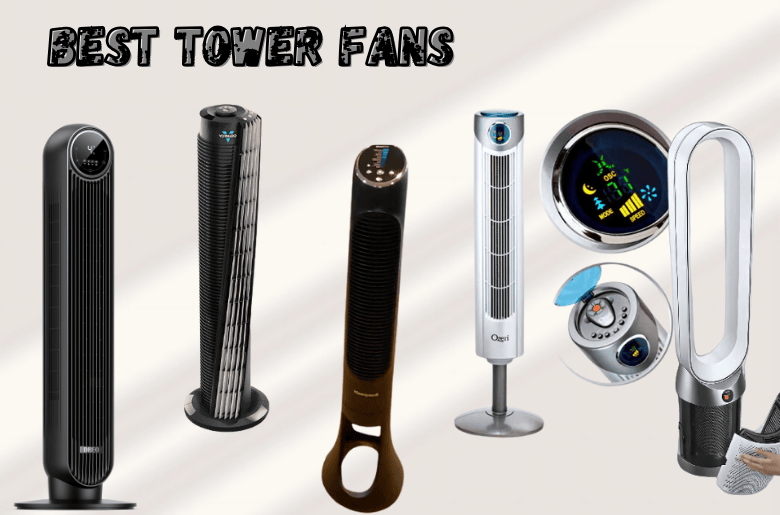
Tower fans have become an essential appliance in modern households, offering efficient cooling, a space-saving design, and advanced features. The original version of this post was a decent buyer’s guide — but its lead pick (the Dyson TP04) has been discontinued, it called a 36-inch fan a “desk fan”, and it never told you the one thing that matters most: a tower fan does not cool a room. It moves air; the cooling you feel is wind chill on your skin. A fan left running in an empty room slightly warms it. Here is the corrected guide.
What to Look For
- Room size. Small rooms (up to ~150 sq ft) suit compact fans; large rooms need a taller fan with more airflow (look for 300+ CFM).
- Noise level. Good tower fans run roughly 30–50 dB on low (a quiet bedroom is ~30 dB). For a bedroom, look for under 50 dB on the lowest setting.
- Oscillation. A wider angle (90° is standard; some Dyson models go to 350°) covers more of the room.
- Speed settings and modes. Three or more speeds, plus a sleep mode and a timer, cover most needs.
- Remote control. Essential for a bedroom fan — you will not want to get up to change it.
- Energy use. Tower fans typically use 30–60W, versus 1,000–3,500W for an air conditioner. That is the real saving.
- Air purification. Only some models (Dyson) have HEPA filtration. Do not buy a fan for its ionizer — ionizers add little to air cleaning and some produce ozone.
The Best Tower Fans
Dyson Purifier Cool TP07 — Best for Air Purification and Cooling
The original’s pick, the TP04, has been discontinued; the current equivalent is the TP07. It is a premium tower fan that doubles as an air purifier, with HEPA filtration (Dyson claims it captures 99.95% of particles as small as 0.1 microns), a bladeless Air Multiplier design for smooth, quiet airflow, oscillation up to 350°, and app and voice control. Price: ~$549–$649. Worth it if you want purification as well as cooling; overkill if you just want a breeze.
Lasko Wind Curve T42950 — Best Value for Money
A popular tower fan that combines functionality with affordability. Three quiet speed settings, a slim space-saving design, a timer, a remote control, and wide oscillation. It also has a built-in ionizer — a feature of little real value. Price: ~$60–$80.
Honeywell QuietSet HYF290B — Best for Quiet Operation
If you want a tower fan for a bedroom or office, the QuietSet is an excellent choice: eight adjustable speed settings, including a sleep mode that provides a gentle breeze with minimal noise, and a slim design for small spaces. Price: ~$70–$90.
Vornado 184 Whole Room Tower Air Circulator — Best for Large Rooms
Vornado fans use a vortex design that circulates air throughout the entire room rather than blowing in one direction. Four speed settings and a sleek design. Price: ~$90–$110.
Ozeri OZF1 Ultra 42-Inch — Best for Customisable Features
Three airflow patterns (normal, nature, and sleep modes), a 42-inch height, remote control, and a programmable timer. Price: ~$70–$90.
Dreo Nomad One — Best for Small Rooms
A compact 36-inch tower fan for desktops-adjacent small rooms and offices — not, as the original claimed, a desk fan. Quiet, minimalist, and effective for its size, with a remote and a timer. Price: ~$50–$70.
Tower Fan vs Air Conditioner
A tower fan uses 30–60W and cools you (wind chill). An air conditioner uses 1,000–3,500W and cools the room. In mild heat, a fan is enough and far cheaper to run. In a heatwave, a fan alone will not keep a room comfortable — use it with air conditioning to circulate the cool air, or use it to make a warm room feel cooler at a higher thermostat setting.
Energy Efficiency Tips
Position the fan near a window or doorway to maximise natural airflow, and combine it with a ceiling fan to circulate air more effectively. Use programmable timers or smart plugs so the fan runs only when needed. Clean the vents regularly — dust buildup reduces airflow and strains the motor.
How to Maintain Your Tower Fan
Clean the vents and grille regularly with a vacuum or a damp cloth. Only purifier models (like the Dyson) have a filter to check and replace — most tower fans have none. Store the fan covered during the off-season to keep dust out.
The Bottom Line
For most people, the Lasko Wind Curve T42950 (~$60–$80) is the best value, and the Honeywell QuietSet HYF290B (~$70–$90) is the best bedroom pick. Buy the Dyson TP07 (~$549–$649) only if you also want air purification. And remember: a tower fan cools you, not the room — in a heatwave, it is a complement to air conditioning, not a replacement.
Visit our Tech category for more tech guides.
Frequently Asked Questions (FAQs)
Do tower fans cool a room?
No. A tower fan moves air; the cooling you feel is wind chill on your skin. It does not lower the room’s temperature — a fan left running in an empty room slightly warms it.
Are tower fans energy efficient?
Yes — they typically use 30–60W, versus 1,000–3,500W for an air conditioner. They are far cheaper to run, but they do not replace air conditioning in a heatwave.
Which tower fan is best for a bedroom?
The Honeywell QuietSet HYF290B — eight speeds including a sleep mode, and quiet operation (look for under 50 dB on the lowest setting).
Which tower fan is best for large rooms?
The Vornado 184 (vortex circulation) or the Dyson TP07 (350° oscillation plus air purification).
Is the Dyson TP04 still available?
No — it has been discontinued. The current equivalent is the Dyson Purifier Cool TP07 (~$549–$649).
How loud are tower fans?
Good ones run roughly 30–50 dB on low. A quiet bedroom is about 30 dB; normal conversation is about 60 dB.
