

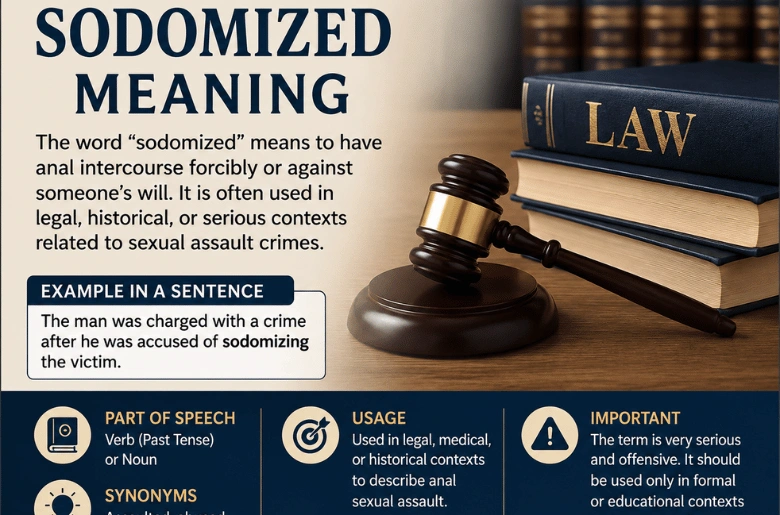
Sodomized Meaning: If you searched for the meaning of sodomized,” you may have seen the word in a news story, court report, book, or online discussion. It is a sensitive sexual term, and the surrounding context affects what the writer intends to communicate. Elsewhere on the site: Testamentary Meaning in U.S. Law.
| Key point | Explanation |
| Word type | Past tense and past participle form of sodomize |
| Basic sense | To engage in or subject someone to an act historically described as sodomy |
| Common modern context | Legal reports, news, history, and serious discussions |
| Consent | The word alone does not always establish whether an act was consensual. |
| Tone | Formal, sensitive, and sometimes considered offensive or outdated. |
| Related terms | Sodomy, sexual assault, anal intercourse, oral intercourse |
Quick answer: Sodomized is the past tense and past participle form of sodomize. It usually means that someone engaged in, or was subjected to, an act historically called sodomy, most often oral or anal sexual activity. The word does not automatically establish a lack of consent, so the surrounding legal, news, or historical context matters.
Key Takeaways
- The term comes from the verb “sodomize” and the noun “sodomy.”
- Modern definitions commonly associate sodomy with oral or anal sexual activity.
- Lack of consent changes the issue from a description of sexual conduct to possible rape or sexual assault.
- Legal wording differs among jurisdictions, so context matters.
- The word has a history of stigmatizing same-sex sexual activity and may be inappropriate in casual writing.
What Does “Sodomized” Mean in Plain English?

The simplest explanation is that the word is the past-tense form of sodomize. The related noun “sodomy” has historically covered several sexual acts, although modern definitions commonly focus on oral or anal intercourse.
That means you should not assume that every use of the term carries the same implication. A historical text, a criminal allegation, a dictionary entry, and a modern news article may use it somewhat differently.
For more plain-English language explanations, ReadRey also publishes educational vocabulary content, including its explanation of “What Does Squabble Up Mean?”
Does “sodomization” mean “always mean rape” or “sexual assault”?
No. The dictionary meaning of sodomy does not necessarily imply a lack of consent. Consent becomes crucial when the word appears in a criminal allegation or a description of violence. Non-consensual anal penetration or forced oral sexual activity may be classified as rape or sexual assault, depending on the applicable law.
Sodomized Meaning So, a sentence describing someone as having been subjected to the act against their will carries a very different meaning from a general discussion of consensual sexual activity.
Sodomy, Sodomize, and Sodomized Meaning: What Is the Difference?

These words are closely related, but they perform different grammatical functions.
| Term | Word type | Simple explanation |
| Sodomy | Noun | The act or category of sexual conduct |
| Sodomize | Verb | To engage in that act with another person |
| Sodomized | Past-tense verb / past participle | Indicates that the action occurred in the past |
Definitions of sodomy have included oral and anal sexual activity. Historical definitions have sometimes been broader. Understanding this distinction helps when reading legal documents or news reports. The noun names the conduct, while the verb describes an action.
How Sodomized Is Used in Legal and News Contexts
Legal use requires extra care because criminal statutes do not use identical terminology everywhere. Rape and sexual assault laws can vary by jurisdiction, including how different forms of penetration and lack of consent are classified.
In the United States, Lawrence v. Texas in 2003 established constitutional protection for private, consensual sexual conduct between adults and invalidated laws criminalizing certain forms of consensual same-sex intimacy.
That ruling should not be confused with laws covering force, abuse, minors, or people who cannot legally consent. Those situations involve separate criminal-law questions. Anyone researching an actual allegation should check the law in the relevant jurisdiction rather than relying on a dictionary definition. Readers interested in legal topics can also browse ReadRey’s Law section for other explanatory content.
Why the Word Can Be Sensitive or Outdated

The term has a long history of moral and legal judgment. It has historically been associated with stigmatized sexual acts and laws targeting same-sex conduct.
Modern writers can often communicate more clearly by naming the conduct they mean. Depending on the facts, phrases such as anal intercourse, oral sex, sexual assault, or rape may be more precise.
This matters most when discussing victims or allegations of violence. Specific language can distinguish consensual sexual behavior from abuse without adding unnecessary stigma.
Examples of the Word in Sentences
Because this is a sensitive term, examples should be neutral and contextual.
- “The historical record used the term to describe conduct that was illegal at the time.”
- “The report alleged that the victim had been sodomized against his will.”
- “The researcher explained how older laws defined sodomy differently from modern sexual-offense statutes.”
The second example signals alleged non-consensual conduct because the sentence explicitly says that it happened against the person’s will. The verb by itself does not provide every relevant legal detail.
For health-related educational material, readers can also explore ReadRey’s Health section.
Where Does the Term Come From?
The noun “sodomity” traces back through medieval Latin to Sodom, the biblical city associated with the story of Sodom and Gomorrah. The term entered English during the Middle Ages and gradually became associated with sexual acts that certain societies, religious traditions, or legal systems condemned.
That history helps explain why the term can carry moral, religious, or stigmatizing overtones, even when someone intends to use it only as a clinical description.
Language has changed as legal systems and social attitudes have evolved. More specific terms are now often clearer for medical, legal, journalistic, and educational writing.
The Main Point to Remember

The clearest way to understand this word is to read the entire sentence around Sodomized Meaningit. Determine whether the writer is discussing consensual conduct, an alleged assault, historical law, or older terminology.
For more explanations of unfamiliar words and expressions, visit ReadRey’s Education section. Clear context matters more than treating one sensitive term as though it always carries a single legal meaning.
Conclusion
Understanding Sodomized Meaning requires more than looking at the word alone. Its meaning can change significantly depending on whether it appears in a historical discussion, dictionary definition, news report, medical context, or legal allegation. The term itself does not automatically establish that rape or sexual assault occurred; questions of force, consent, age, and legal classification depend on the circumstances and the applicable law.
Because the word also carries historical and sometimes stigmatizing associations, modern writing often benefits from using more precise language that clearly describes the conduct or allegation being discussed. Ultimately, the surrounding context is essential. When reading legal or news material, readers should avoid assuming a specific legal conclusion from the word “sodomized” meaning alone and should look at the complete sentence, facts, and relevant jurisdiction.
Frequently Asked Questions
The phrase “sodomized” refers to the definition of a past-tense verb describing an act historically classified as sodomy. Modern definitions commonly connect sodomy with oral or anal sexual activity. Context determines whether the sentence also implies force or a lack of consent.
No. The term alone does not necessarily establish a lack of consent. If anal penetration or forced oral sexual activity occurs without consent, it may fall within definitions of rape or sexual assault, depending on the applicable law.
Yes. Dictionary and historical legal uses of the term have described sexual acts regardless of whether they were consensual. Older laws sometimes criminalized consensual adult conduct as well.
It can still appear in statutes, police reports, court discussions, or older legal materials. Modern jurisdictions, however, may use more specific terms such as rape, sexual assault, oral sexual contact, or anal sexual contact. Exact terminology depends on local law.
It can be. The term has historical links to laws and social attitudes that stigmatized gay people and same-sex sexual behavior. When precision is possible, modern writers may prefer a specific description of the act or offense.
