

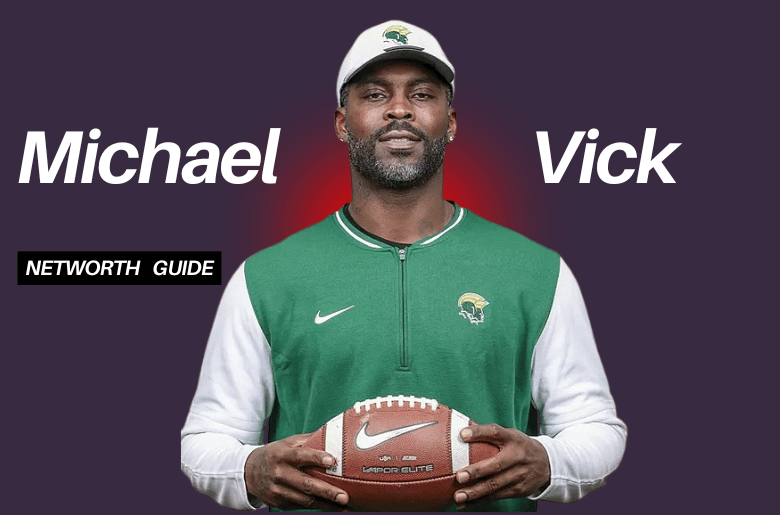
Michael Vick earned $115.9 million in NFL salary alone. Most published estimates put his net worth today at roughly $4 million. That gap — more than $110 million — is the real story behind the search, and almost nobody explains it properly.
This guide traces the money end to end: what Vick actually banked, what the 2008 bankruptcy took back, how much he repaid his creditors, and what he earns now as a college head coach in his second season at Norfolk State. Along the way it corrects several numbers that circulate widely and are simply wrong.
Michael Vick Net Worth in 2026
Michael Vick’s net worth in 2026 is most commonly reported as around $4 million. You will also see figures near $16 million on other sites. Both numbers get repeated as fact, so it is worth understanding why they differ.
The lower figure comes from Celebrity Net Worth, which has kept Vick at $4 million for years — a number anchored to the aftermath of his Chapter 11 bankruptcy, when a court-supervised repayment plan claimed most of his post-prison income. The higher estimates typically start from his gross career earnings and subtract taxes and known losses, without fully accounting for the roughly $17.6 million that went back to creditors.
Neither is audited. No public figure’s net worth is, unless they run a listed company. What can be verified is the flow of money in and out, and that is where the honest answer lives: Vick’s fortune was rebuilt, not restored. He is comfortable, debt-free and drawing a steady salary — but he is not sitting on a nine-figure pile, and he never really was.
Michael Vick: Quick Facts
| Category | Details |
| Full Name | Michael Dwayne Vick |
| Date of Birth | June 26, 1980 |
| Age | 46 |
| Birthplace | Newport News, Virginia, USA |
| Height | 6 ft 0 in (1.83 m) |
| Playing Weight | 210 lbs (95 kg) |
| College | Virginia Tech (1998–2000) |
| NFL Draft | 2001, 1st overall pick, Atlanta Falcons |
| NFL Teams | Atlanta Falcons (2001–2006), Philadelphia Eagles (2009–2013), New York Jets (2014), Pittsburgh Steelers (2015) |
| Career NFL Earnings | $115,952,908 |
| Estimated Net Worth (2026) | ~$4 million (estimates range up to $16 million) |
| Current Role | Head football coach, Norfolk State University |
| Coaching Salary | $400,000 base per year |
| Pro Bowls | 4 (2002, 2004, 2005, 2010) |
| Major Award | NFL Comeback Player of the Year (2010) |
| Signature Jersey | No. 7, Atlanta Falcons and Philadelphia Eagles |
Where the Money Came From: $115.9 Million in NFL Earnings

Vick’s on-field earnings total $115,952,908 across four franchises. Atlanta accounts for more than $57 million of that and Philadelphia for roughly $53.5 million; the Jets and Steelers years added comparatively little.
| Contract | Year | Reported Terms |
| Falcons rookie deal | 2001 | 6 years, ~$62 million |
| Falcons extension | 2004 | 10 years, ~$130 million — the richest contract in NFL history at the time |
| Eagles free-agent deal | 2009 | 2 years, ~$6.8 million |
| Eagles extension | 2011 | 6 years, reported at up to $100 million (~$40 million guaranteed) |
| New York Jets | 2014 | 1 year, ~$5 million |
| Pittsburgh Steelers | 2015 | 1 year, near league minimum |
Two things about that table matter more than the headline numbers. First, NFL contracts are not guaranteed the way NBA or MLB deals are, so the “$130 million” and “$100 million” figures were always ceilings rather than payouts. Vick never came close to collecting either in full. Second, the 2004 Atlanta extension was terminated by his conviction — the Falcons pursued repayment of bonus money, and roughly $20 million of that agreement never reached him.
Endorsements Before and After 2007
At his commercial peak Vick was one of the most marketable athletes in American sport. Nike built a signature line around him, and he carried deals with Coca-Cola, Kraft, Powerade and EA Sports, including the cover of Madden NFL 2004. Industry estimates at the time placed his annual endorsement income in the millions.
Every one of those partnerships ended within weeks of his 2007 indictment. Nike re-signed him in 2011 after several years of animal-welfare advocacy, and he added smaller deals with the supplement brands Fuse Science and MusclePharm the same year — but the endorsement income of his second act was a fraction of the first.
Where the Money Went: The 2008 Bankruptcy
This is the section most net worth articles skip, and it is the entire explanation.
Vick filed for Chapter 11 bankruptcy in July 2008, while still in federal prison, listing roughly $17.6 million in debt. Chapter 11 matters here: unlike Chapter 7, it reorganises debt rather than erasing it, which meant Vick committed to paying his creditors back out of future earnings.
The creditor list showed how much of the damage was self-inflicted through bad investments rather than legal costs alone. Reported claims included around $4.5 million owed to sports agents, $3.75 million to the Atlanta Falcons in disputed bonus money, and several million more to banks behind failed ventures — among them a rental car business and a wine shop.
Court filings covering 2007 to 2012 indicate roughly $30 million passed through Vick’s hands in that window and went straight out again to taxes, legal fees and creditors. He lived on a court-approved allowance during the Eagles years while the bulk of each cheque was routed to the repayment plan.
In late 2017 he made a final payment of about $1.5 million and cleared the plan — repaying essentially the full $17.6 million. It is a genuinely unusual outcome. Most high-earning athletes who file for bankruptcy discharge their debts; Vick paid his.
That is the arithmetic behind the $4 million figure. Gross earnings of roughly $116 million, minus federal and state tax at the rates applying to the highest earners, minus around $17.6 million in repayments, minus agent and legal fees, minus the investment losses that caused the filing in the first place — and the remainder is not a fortune. It is a solid, ordinary balance sheet belonging to a man who once signed the largest contract in his sport.
What Michael Vick Earns Now
Vick’s income today comes from three places, and none of them resemble an NFL contract.
Coaching Salary
Norfolk State University hired Vick as head football coach in December 2024. His four-year contract runs through December 21, 2028 and pays a base salary of $400,000 a year, plus a full-size university vehicle. By FCS and HBCU standards that is a strong package; by NFL standards it is roughly what he used to earn in a fortnight.
The deal includes performance incentives: $10,000 for a MEAC regular-season championship, $15,000 for each NCAA playoff win, $2,500 for Conference or AFCA Coach of the Year, $5,000 for NCAA Coach of the Year, and $100,000 for an FCS national championship. He also earns an automatic one-year extension if Norfolk State finishes in the top half of the MEAC by his third season.
Broadcasting
Vick worked as an NFL analyst for Fox Sports from 2017 until taking the Norfolk State job, appearing on studio coverage and pre-game programming. Network analyst salaries are not disclosed, but the role provided steady six-figure income across seven seasons and kept his profile intact through the years when playing money had stopped.
Business Ventures and Appearances
Vick launched the V7 apparel line in 2012, with proceeds supporting the Boys and Girls Club of Philadelphia. He joined Levels Sports Group as Head of Athlete Development in 2022, co-founded the fan-engagement platform FanField, and runs youth football camps. He also draws income from autograph signings and memorabilia — his Eagles No. 7 remains one of the better-selling retired-player jerseys.
Michael Vick’s Coaching Career at Norfolk State

Vick was named head coach at Norfolk State on December 20, 2024 and introduced days later, taking over a programme coming off a 4-8 season. He had no previous head-coaching experience at any level, and the first year showed it.
The 2025 Spartans finished 1-11 and went winless in MEAC play. Vick has been direct about it rather than defensive, telling reporters at 2026 media day that the team does not “shy away” from the record and will treat the disappointment as motivation instead of baggage. He rebuilt the roster and coaching staff through the offseason and made accountability the stated centre of the rebuild.
Year two opened very differently. On August 29, 2026, Norfolk State beat Winston-Salem State 56-0 at William “Dick” Price Stadium, out-gaining their opponent 457 yards to 106 and leading 21-0 at half before adding 35 in the second half. Quarterback Deljay Bailey threw three touchdowns and ran for another. Vick called the result a test of the work done since January and told his squad to keep the “foot on the gas” against stiffer competition ahead.
For a net worth question, the coaching job is the important part: it is his primary income and the thing most likely to move his finances over the next few years. A successful FCS tenure puts bigger jobs and bigger salaries within reach.
Michael Vick’s NFL Career and Statistics
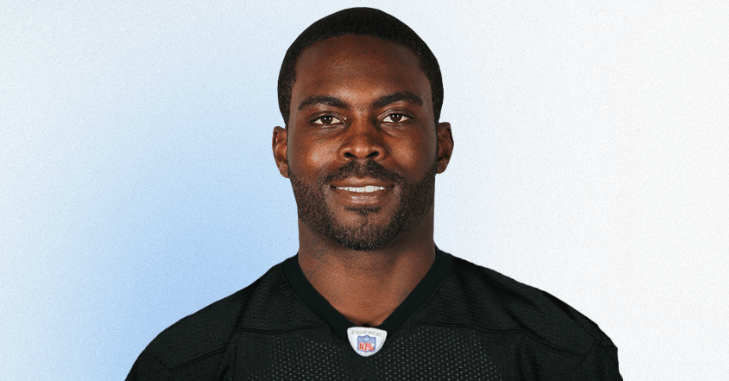
| Statistic | Career Total |
| Games played / started | 143 / 115 |
| Record as starter | 61-51-1 |
| Completions / attempts | 1,807 / 3,217 (56.2%) |
| Passing yards | 22,464 |
| Passing touchdowns | 133 |
| Interceptions | 88 |
| Passer rating | 80.4 |
| Rushing attempts | 873 |
| Rushing yards | 6,109 (7.0 per carry) |
| Rushing touchdowns | 36 |
One number on that list deserves more attention than it gets: 7.0 yards per carry, sustained over 873 rushing attempts. For context, Jim Brown averaged 5.2 for his career and Barry Sanders 5.0. Vick was not simply a quarterback who could run when a play broke down — he gained ground at a rate no featured running back in league history has come close to matching.
Atlanta Falcons (2001–2006)
Atlanta traded up to take Vick first overall in 2001. He started only two games as a rookie and did not win Offensive Rookie of the Year — that award went to Chicago running back Anthony Thomas, a detail frequently attributed to Vick in error.
He took over as starter in 2002 and made the Pro Bowl, then led the Falcons to an upset road playoff win at Green Bay — the first postseason defeat Brett Favre had ever suffered at Lambeau Field. Further Pro Bowls followed in 2004 and 2005, and in 2004 he took Atlanta to the NFC Championship Game.
The defining season came in 2006, when Vick rushed for 1,039 yards and became the first quarterback in NFL history to pass 1,000 rushing yards in a single season. That record belongs to his Atlanta years, not his Philadelphia ones — another point routinely garbled online.
Philadelphia Eagles (2009–2013)
Philadelphia signed Vick in August 2009 as a backup, a move that drew heavy criticism at the time. He spent that season in a limited role behind Donovan McNabb before taking the starting job early in 2010.
The 2010 season was the best of his career. Vick threw 21 touchdowns against six interceptions, added nine rushing scores, posted a career-high 100.2 passer rating and led the Eagles to the NFC East title. He earned his fourth Pro Bowl selection and the NFL Comeback Player of the Year award. His Monday night performance at Washington that November — six total touchdowns before half-time — is still cited as one of the great individual games in league history.
Injuries and turnovers eroded the following seasons, and Vick lost the job to Nick Foles in 2013.
New York Jets and Pittsburgh Steelers (2014–2015)
Vick signed with the Jets in 2014 as a veteran backup and started three games. He joined Pittsburgh in 2015 after an injury to Ben Roethlisberger, starting three more, and retired in February 2017 as a member of the Falcons after signing a ceremonial one-day contract.
College Career at Virginia Tech
Vick redshirted in 1998 and played two seasons for the Hokies. His college totals are far more modest than the inflated numbers that circulate: 3,279 passing yards on 187 of 332 attempts (56.3%) with 21 touchdowns and 12 interceptions, plus 1,216 rushing yards and 17 rushing touchdowns on 223 carries.
The impact was never really about volume. As a redshirt freshman in 1999 he led Virginia Tech to an undefeated regular season and the national championship game against Florida State, finished third in Heisman Trophy voting as a redshirt freshman, and won the Archie Griffin Award as college football’s most valuable player, Big East Offensive Player of the Year honours and first-team All-America selection. He entered the draft after his sophomore year.
The Dogfighting Conviction and Prison Sentence
In April 2007 a property Vick owned in Surry County, Virginia was searched in a drugs investigation involving a relative. Investigators found evidence of a dogfighting operation known as Bad Newz Kennels. Vick was indicted in July 2007 on federal conspiracy charges and pleaded guilty the following month.
He was sentenced to 23 months in federal prison on December 10, 2007, having already surrendered voluntarily in November. He served the bulk of that term at USP Leavenworth in Kansas, moved to home confinement on May 20, 2009, and completed the sentence on July 20, 2009 — roughly 19 months in federal custody in total.
The 23-month sentence and the shorter time actually served are the source of the conflicting “21 months” and “19 months” figures found across the internet. Both refer to real things: 23 months was handed down, less than that was served in custody.
The financial consequences outlasted the sentence. He was suspended indefinitely by the NFL, lost every endorsement, forfeited the remainder of the Atlanta contract and entered bankruptcy. After his release he worked with the Humane Society of the United States on anti-dogfighting campaigns and supported federal legislation on animal cruelty. Public opinion on the sincerity of that work remains divided, and it is fair to say the conviction still shapes how a portion of the public sees him.
Legacy: The Blueprint for the Modern Quarterback

When Vick entered the league in 2001, a quarterback who ran was widely treated as a quarterback who had failed to read the defence. Coaching orthodoxy held that mobility was a fallback, not a weapon, and Black quarterbacks in particular were often pushed toward other positions on that reasoning.
Vick made that position untenable. Defences had to account for him as a runner on every snap, which changed how coordinators designed coverages and how offensive staffs thought about designed quarterback runs. The read-option and RPO concepts that now sit at the centre of NFL offences descend directly from problems Vick created.
Lamar Jackson, Kyler Murray, Jalen Hurts and Justin Fields have all named him as the player who made their careers imaginable. Jackson, who broke Vick’s single-season quarterback rushing record in 2019, has been explicit about it. That influence, rather than the passing statistics, is what makes his career historically significant — and it is why his jersey still sells two decades on.
The Bottom Line
Michael Vick’s estimated $4 million net worth in 2026 is not the story of a man who wasted a fortune and disappeared. It is the story of a man who earned $116 million, lost most of it to a criminal conviction and a string of bad investments, then chose to repay $17.6 million he could legally have walked away from — and rebuilt from there on a college coach’s salary.
Judged as a balance sheet, it is a cautionary tale about athlete finances. Judged as a decade of decisions, it is something closer to the opposite. If you follow other athletes’ finances, our breakdowns of John Madden’s net worth and Dwyane Wade’s net worth cover two very different approaches to life after the game.
Frequently Asked Questions
What is Michael Vick’s net worth in 2026?
Michael Vick’s net worth is most commonly estimated at around $4 million in 2026, though some outlets place it as high as $16 million. The lower figure reflects the impact of his 2008 bankruptcy and the $17.6 million he repaid to creditors.
How much money did Michael Vick make in the NFL?
Vick earned $115,952,908 in NFL salary across 13 seasons — more than $57 million with the Atlanta Falcons and roughly $53.5 million with the Philadelphia Eagles, plus smaller amounts from the Jets and Steelers.
Why is Michael Vick’s net worth so low compared to his earnings?
Three factors: taxes at the top rate on roughly $116 million of income, the loss of his Atlanta contract and all endorsements after his 2007 conviction, and a Chapter 11 bankruptcy in which he repaid essentially all of his $17.6 million debt rather than discharging it.
How long did Michael Vick spend in prison?
He was sentenced to 23 months on December 10, 2007 for his role in a federal dogfighting conspiracy. He moved to home confinement on May 20, 2009 and completed the sentence on July 20, 2009, serving roughly 19 months in federal custody.
What does Michael Vick do now?
He is head football coach at Norfolk State University, hired in December 2024 on a four-year contract worth $400,000 a year through 2028. His team opened the 2026 season with a 56-0 win over Winston-Salem State after finishing 1-11 in his first year.
Did Michael Vick pay back his bankruptcy debt?
Yes. He filed Chapter 11 in 2008 with $17.6 million in debt and completed repayment in late 2017 with a final payment of about $1.5 million — an unusual outcome, since most athletes who file for bankruptcy have their debts discharged instead.
What number did Michael Vick wear?
He wore No. 7 with both the Atlanta Falcons and the Philadelphia Eagles, and it remains one of the best-selling retired-player jerseys in the NFL. He wore No. 1 with the Jets and No. 2 with the Steelers.
How tall is Michael Vick and what did he weigh?
Vick stands 6 feet 0 inches (1.83 m) and played at 210 lbs (95 kg) — small for an NFL quarterback, which made his durability across 143 games more notable than it is usually given credit for.
