

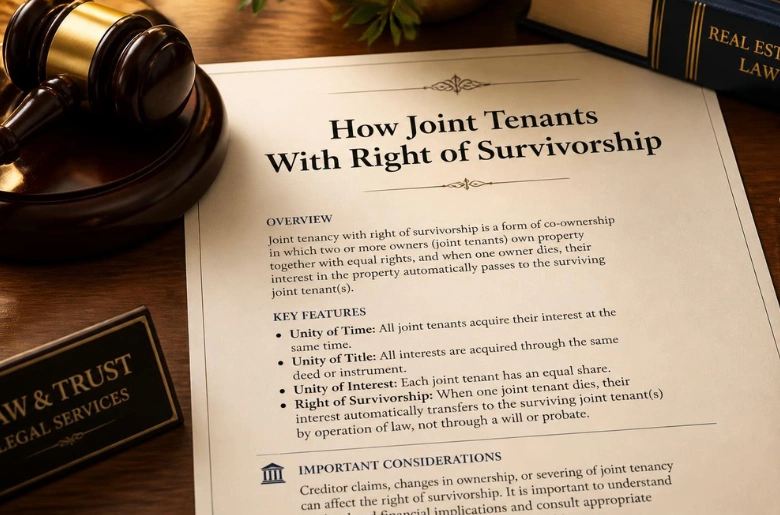
Joint Tenants with right of survivorship is a form of shared ownership in which a deceased owner’s interest passes automatically to the surviving owner or owners. It can keep that asset out of probate, but state deed rules, creditor exposure, control issues, and federal tax consequences can make it a poor fit for some owners.
People often choose survivorship ownership because they want property to transfer quickly after death. That benefit can be useful, but the title can also override instructions in a will and affect what each co-owner can do while alive. If you are researching a house or other property, Readrey’s Real Estate section offers more information about ownership and home transactions.
| Key question | General U.S. answer |
| What happens when one owner dies? | The deceased owner’s interest generally passes to the surviving co-owner or owners. |
| Does the asset go through probate? | A valid survivorship interest generally passes outside the deceased owner’s probate estate. |
| Can a will leave the share to someone else? | Usually not while the survivorship arrangement remains valid. |
| Can an owner transfer an interest while alive? | Often yes, but a transfer may sever survivorship rights for that interest. |
| Are there tax consequences? | Yes. Basis, estate-tax inclusion, and possible gift-tax reporting can depend on the facts. |
| Are the rules identical nationwide? | No. Property and deed rules depend on state law. |
Key Takeaways
- Survivorship rights can transfer an ownership interest without probate.
- A will generally cannot redirect a valid survivorship interest after an owner dies.
- State law controls how joint tenancy is created, changed, severed, and documented.
- Adding another person to the title can create tax and creditor consequences before anyone dies.
- Tenancy in common, tenancy by the entirety, trusts, and beneficiary-based tools may fit different estate plans.
How Joint Tenants With Right of Survivorship Work

Joint tenancy is a form of co-ownership in which each owner has an undivided interest in the property. The defining feature is the right of survivorship, which causes a deceased owner’s interest to be absorbed by the surviving owner or owners. Joint tenants with right of survivorship use this arrangement to allow an ownership interest to pass automatically to the surviving co-owner rather than through the deceased owner’s estate. Cornell’s Legal Information Institute explains that survivorship is what distinguishes this arrangement from ownership forms that allow a deceased owner’s share to pass through an estate.
Traditional property law also refers to requirements involving time, title, interest, and possession when a joint tenancy is created. State statutes and modern deed rules can modify how those concepts apply, so owners should not rely on a generic deed phrase found online. The American Bar Association advises property buyers to identify both the parties taking title and the exact manner in which title will be held.
What Happens When One Owner Dies?
When one co-owner dies, the survivorship provision generally transfers that person’s property interest to the remaining owner or owners by operation of law. The transferred interest is ordinarily outside the deceased owner’s probate estate, which can reduce the court administration needed for that particular asset. This does not mean that the deceased person’s entire estate avoids probate.
The survivor may still have paperwork to complete before public records show the new ownership correctly. Depending on the state and county, that process may involve a certified death certificate, an affidavit, or another recording document. The transfer may be automatic as a matter of ownership law even though administrative steps remain necessary to update the title record.
Can a Will Override the Right of Survivorship?
A will generally does not control property that passes through a valid survivorship provision. If one owner dies first, the surviving owner receives the interest under the title arrangement rather than through the deceased person’s will. The American Bar Association warns that jointly owned property can therefore produce results that differ from what someone expected after preparing a will.
This point deserves special attention in blended families and parent-child planning. A parent might add one child to a deed for convenience while expecting that child to share the property with siblings later. Unless the legal documents create that obligation, survivorship ownership may leave the entire property with the named survivor instead.
Joint Tenancy vs. Tenancy in Common
Tenancy in common is another common way for two or more people to own the same property, but it generally has no automatic survivorship feature. A tenant in common can usually leave an ownership share to a beneficiary, and the share may pass through the owner’s estate after death. Cornell notes that ownership percentages may also be unequal under a tenancy in common.
The choice affects inheritance, flexibility, and estate planning rather than only the names printed on a deed. Readers comparing legal ownership arrangements can also browse Readrey’s Law section for related explanations. Because state rules differ, a deed should be reviewed under the law where the property is located.
| Feature | Joint tenancy with survivorship | Tenancy in common |
| Transfer at death | Passes to surviving owner or owners | Passes through the deceased owner’s estate |
| Probate of that interest | Generally avoided | Often required unless another probate-avoidance method applies |
| Will controls the interest. | Generally no | Generally yes. |
| Ownership percentages | Often equal under traditional rules | May be equal or unequal |
| Lifetime transfer | May sever survivorship rights | Usually does not change the other owners’ ownership form |
| Best fit | Owners who want automatic succession | Owners who want separate inheritance control |
Can One Co-Owner Sell or Transfer an Interest?
A co-owner can often convey that person’s interest during life, although the precise consequences depend on state law. A transfer can sever the joint tenancy for the transferred interest and turn that portion into a tenancy in common. Cornell also identifies conveyance and partition among the events that may end survivorship rights.
Selling an ownership interest is different from selling the whole property. A buyer, lender, or title company may require signatures and documentation from all owners before a full-property transaction can close. If a sale is already under contract, Readrey’s guide to backing out of a home sale before closing explains why contract terms and state law matter before an owner tries to cancel.
The Main Benefits and Risks
The strongest benefit is straightforward succession. The surviving owner may receive the deceased owner’s interest without waiting for that interest to move through probate, and title can be easier to administer when the arrangement matches the owners’ estate plan. It can be especially appealing when co-owners genuinely want the last survivor to own the entire asset.
The risks begin when that goal changes or is never clearly understood. A co-owner’s creditors may be able to reach that owner’s property interest under applicable state law, and a transfer may disrupt survivorship rights. The arrangement can also create family disputes when the title sends property to one survivor while a will appears to promise something different.
| Potential advantage | Corresponding risk |
| Automatic transfer at death | The deceased owner loses control over who receives that interest. |
| May avoid probate for the asset | Avoiding probate does not eliminate tax or creditor questions. |
| Simple succession between trusted owners | A co-owner can gain significant legal rights immediately. |
| Useful for some spouses or family members | Blended-family or sibling inheritance plans can be disrupted. |
| Can simplify title after the first death | State-specific recording work may still be required. |
Tax Issues Owners Should Understand
Avoiding probate and avoiding tax are separate issues. Federal tax rules can determine how much jointly owned property is included in a deceased owner’s estate and how the surviving owner calculates tax basis afterward. IRS Publication 551 gives examples showing that the result can depend on contributions, the relationship between the owners, and the amount included in the deceased owner’s estate.
Married couples can face different rules from unrelated co-owners, and community property can have different basis treatment from ordinary joint ownership. A surviving spouse should not assume the entire property receives a new tax basis simply because the title contains survivorship language. Readers exploring the financial side of ownership can also review Readrey’s Finance section before discussing their own figures with a tax professional.
There can also be tax consequences when the ownership arrangement is created rather than when someone dies. IRS Form 709 instructions state that using one person’s funds to create certain joint ownership arrangements with another person can constitute a gift. The exact reporting result depends on the asset, each person’s contribution, marital status, citizenship, and other facts.
Joint Tenancy Is Not the Only Probate-Planning Option
Owners should compare survivorship title with the rest of their estate plan before changing a deed. Tenancy in common may be better when each owner wants a separate share to pass to chosen heirs, while some married couples may have access to tenancy by the entirety under state law. Trusts and state-authorized transfer-on-death tools can also solve different planning problems without giving another person the same immediate ownership rights.
The best choice depends on more than the goal of avoiding probate. Consider who should control the property today, who should inherit it later, whether unequal ownership is needed, and what happens if an owner has creditor or family problems. Those questions often reveal whether automatic survivorship supports the broader plan or conflicts with it.
Before Adding Someone to a Deed
Adding a relative to title can feel simpler than preparing a wider estate plan, but it creates current ownership rights. The new co-owner’s legal and financial circumstances can begin affecting the property while the original owner is still alive. Removing that person later may also require cooperation, another deed, or a legal proceeding under state law.
Before signing, have a local real estate or estate-planning attorney review the proposed deed language and the surrounding estate plan. A tax professional can also explain possible basis and gift-tax consequences based on who paid for the property. Professional review is particularly useful for valuable homes, unmarried co-owners, blended families, and parent-child transfers.
The Bottom Line for U.S. Property Owners
How Joint tenants with right of survivorship ownership can be a useful tool when co-owners clearly want the property to pass to the survivor. Its simplicity at death must be weighed against loss of inheritance control, possible creditor exposure, lifetime transfer issues, and federal tax consequences. The deed should work with the owners’ wills, trusts, tax planning, and family goals rather than operate as a stand-alone shortcut.
Because real-property law is state-specific, have the deed reviewed where the property is located before creating or changing the ownership arrangement. Keep records showing who contributed to the purchase because those records can matter for later tax calculations.
Frequently Asked Questions
Do joint tenants with right of survivorship avoid probate?
The deceased owner’s valid survivorship interest generally passes to the surviving owner outside the probate estate. Other assets owned by the deceased person may still require probate, and the survivor may need to update county or account records. Probate avoidance for one property should therefore not be confused with avoiding estate administration entirely.
Does the surviving owner automatically own everything?
If only two people own the asset and one dies while the survivorship arrangement remains valid, the survivor generally becomes the sole owner. With three or more owners, the deceased person’s interest is generally absorbed by the remaining co-owners. The exact effect should still be confirmed under the applicable deed and state law.
Can one owner leave the property to a child in a will?
A will generally cannot redirect an interest that passes to another owner through a valid right of survivorship. If an owner wants a child or another beneficiary to inherit that share, a different title structure or estate-planning method may be needed. Changing the arrangement should be completed during life and reviewed for state law and tax consequences.
Is survivorship ownership always better for married couples?
No ownership form is automatically best for every married couple. Some states recognize tenancy by the entirety or community-property arrangements that can carry different property, creditor, or tax consequences. Couples should compare the options available in their state before choosing a deed based only on probate avoidance.
